Sri Lanka is a wonderful country with a long history. While the Sri Lankan kings ruled the country hundreds of centuries back, it was later ruled by the Portuguese, Dutch, and British rulers during the colonial period. However, after gaining independence, started the present political era of this island, and since then, a number of significant politicians have contributed to the governance of this country. Among them, Maithripala Sirisena was the seventh executive president of Sri Lanka.
He served the office of the presidency from 9th January 2015 to 18th November 2019. He made history as the first president who came from the North Central province of Sri Lanka. Another significant fact about him is that he does not belong to a traditional Sri Lankan political elite. He came from a family of farmers with a rural background, unlike any other president who ruled the country. Besides, being a low-profile minister, he rose up the ladder to become the president. Moreover, people mostly praise him for his simplicity and for being a personality with great character and integrity.
Likewise, there are many reasons for him to become a highlight in Sri Lankan political history. So, here is all you should know about Maithripala Sirisena, a parliamentarian, and the former president of Sri Lanka!
Childhood and Early Life of Maithripala Sirisena
Maithripala Sirisena’s full name is Pallewatta Gamaralalage Maithripala Yapa Sirisena. He was born on the 5th of September in 1951 in Yagoda. It is a small village in the Gampaha district.
Sirisena is the eldest child of a family of 12 children. Accordingly, he has 5 brothers and 6 sisters. His father is Pallewatta Gamaralalage Albert Sirisena who was a world war II veteran. His mother is Yapa Appuhamilage Dona Nandawathi who was a school teacher. As a world war II veteran, his father received 5 acres of land from the Polonnaruwa area. This made the Sirisena family move from Yagoda to Polonnaruwa close to the Parakrama Samudraya.
Maithripala Sirisena received his education from Thopawewa Maha Vidyalaya and Rajakeeya Madya Maha Vidyalaya in Polonnaruwa. He first developed an interest in politics during his time as a student at the Rajakeeya Madya Maha Vidyalaya in Polonnaruwa. He also studied at the Sri Lanka School of Agriculture in Kundasale for three years. There he earned a diploma in agriculture in 1973. Sirisena is also a student at the Maxim Gorky Literature Institute in Russia. From there, he earned a diploma in political science in 1980.
He first started working as a purchasing officer at the Palugasdammana Multi-Purpose Cooperative society. Then, he became a Grama Niladhari (village officer) in 1976 and resigned in 1978.
Personal Life of Maithripala Sirisena
Maithripala Sirisena stands out among Sri Lankan politicians as a teetotaler, vegetarian, and Theravada Buddhist. Sirisena married Jayanthi Pushpa Kumari in the late 1970s. The couple has two daughters (Chathurika, and Dharani) and one son (Daham) together.
Chathurika Sirisena wrote a book about her father titled ‘Janadhipathi Thaththa’. This book became popular as the first biography written by a daughter of a Sri Lankan president. However, it received criticisms later as there were allegations about the book being ghostwritten by an employee of the media gang of Chathurika Sirisena. Daham Sirisena has also been involved in multiple assaults but his charges have since been withdrawn.
How Maithripala Joined Politics
As a teenager, Sirisena grew an interest in communism. As a result, he joined the Ceylon Communist Party. Then, he became the secretary of the Sri Lanka Free Party’s (SLFP) youth organization in Polonnaruwa at the age of 17. Sirisena was allegedly involved in the Janatha Vimukthi Peramuna (JVP) insurrection, for which he was imprisoned for 15 months at the age of 19.
Afterward, he joined the All Ceylon SLFP Youth Organization and then obtained the SLFP membership in 1978. Subsequently, Sirisena could become the organization’s president and then the treasurer.
During the 1981 presidential elections, he was the chief organizer of the SLFP in the Polonnaruwa area. He could be a part of the mainstream politics of the country in 1989 as a member of the parliament. Since 1994, he has held several ministries.
Legislative Career of Maithripala Sirisena
Maithripala Sirisena was a consecutive member of the parliament since 1989. Further, he has been the general secretary and the deputy president of the Sri Lanka Freedom Party. Under the new government led by Chandrika Kumaratunga, Sirisena served as the deputy minister of Irrigation in 1994. In 1997, he got a promotion as the minister of Mahaweli development. Under his term, he has initiated several important projects such as irrigation projects in Moragahakanda, Walawe, and Kalu rivers.
In 2004, he became the Minister of river basin development and Rajarata development again under the presidency of Chandrika Kumaratunga. Moreover, Sirisena became the minister of Agriculture, Environment, Irrigation, and Mahaweli development under the governance of Mahinda Rajapaksa, the newly elected president in 2005. The popular ‘Api wawamu-Rata nagamu’ (meaning – let’s farm, and develop the country) concept was initiated by him. This highly successful project received much recognition and appreciation as it improved local food production on a national scale.
In April 2010, Maithripala Sirisena was appointed as the minister of health after the parliamentary elections. Under his term, he initiated projects to reduce cigarette and alcohol consumption in Sri Lanka. In addition, he introduced a national drug policy as well. This was primarily based on the Sri Lanka National Pharmaceutical policy of Senaka Bibile. Because of his service as the minister of health in Sri Lanka, he could become one of the vice presidents of the world health assembly. Apart from that, he has also served and been involved in many parliamentary committees.
Maithripala Sirisena as the President
Maithreepala’s presidential journey is quite controversial and interesting at the same time. So, let’s first get to know he conducted his presidential campaign to pave his path toward the presidency.
Presidential Campaign
In order to challenge the corruption and nepotism of the Rajapaksa regime, Maithripala Sirisena announced that he will be competing in the 2015 presidential elections against the incumbent Mahinda Rajapaksa. One of his main pledges as the presidential candidate was that he is going to abolish the executive presidency within 100 days of his appointment.
After his announcement, Sirisena and some of his followers were expelled from the SLFP and their ministerial positions in the government. He released a manifesto for his presidential campaign named ‘A Compassionate Maithri Governance-a stable country’. This carried all the pledges of a government under Maithripala Sirisena.
However, he received many criticisms from the Rajapaksa supporters. Meanwhile, he received much recognition from a considerably large group of Sinhalese, as well as minority communities and supporters of other political parties as the candidate of the common opposition. Accordingly, Maithripala Sirisena could win the presidential election as the winner of 12 electoral districts.
His Presidency
Maithripala Sirisena received a majority of votes with a percentage of 52.42% while Mahinda Rajapaksa received only 47.58%. Accordingly, Maithripala assumed duties as the 7th executive president of Sri Lanka.
He appointed Ranil Wickremasinghe as the prime minister along with the ministerial duties of reconciliation, policy development, and economic affairs. Under his term, SLFP agreed to form the government with the support of the United National Party (UNP) for two years.
Later, Sirisena appointed Mahinda Rajapaksa as his prime minister on the 26th of October 2018 in a sudden move that pushed the country towards a constitutional crisis. However, after a full bench of the Supreme court, Ranil Wickremasinghe was reappointed as the prime minister of Sri Lanka.
One of the most unfortunate incidents which happened under the presidency of Maithripala Sirisena is the 2019 Easter bombings. A series of suicide bombings took place on the 21st of April 2019 around Colombo targeting Catholic churches and some five-star hotels. This incident killed 253 people and left over 500 people wounded. After this, the general public highly criticized President Maithripala Sirisena and his government for their lack of attention towards the intelligence services of the country which led to such a tragedy. The aftermath of the Easter Sunday bombings had a huge impact on the downfall of the Sirisena government.
Post Presidency
On 18th November 2019, Maithripala Sirisena ended his term as the president and decided not to compete in the upcoming presidential elections. Again, he got the appointment as the chairman of the Sri Lanka Freedom Party and again entered the parliament from the Polonnaruwa district with the highest number of votes.
However, according to the Easter bombing inquiry findings, Maithripala Sirisena was stated responsible for failing to prevent the attacks due to the negligence of multiple intelligence service warnings and was ordered to pay 100 million rupees as compensation for the victims of the Easter bombing attacks. He also publicly apologized to the Catholic community.
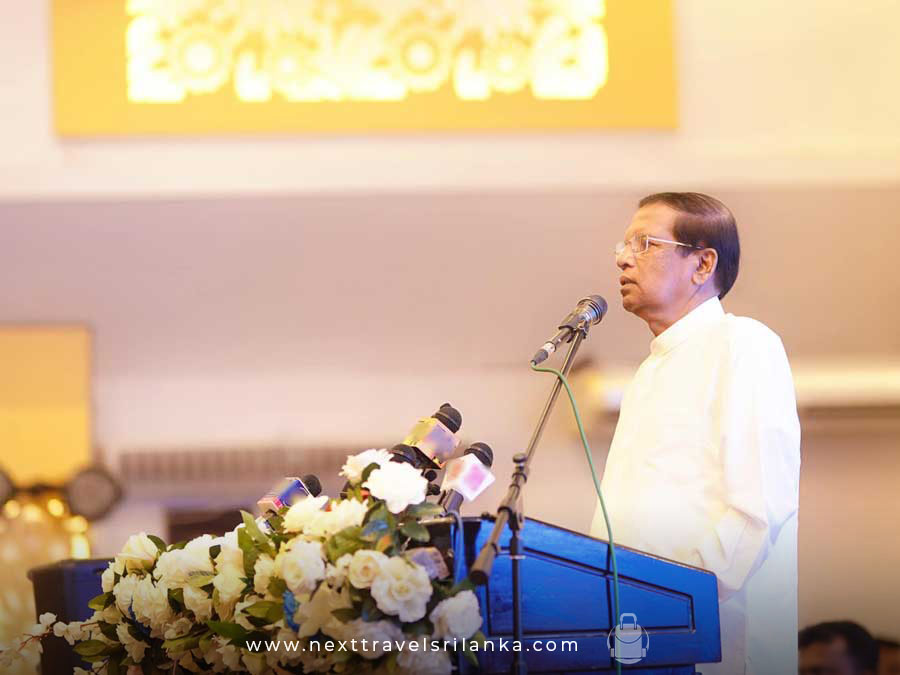
Recently, Sirisena stated that he wishes to participate in the 2024 presidential elections. He issued this statement at a conference for the Sri Lanka Freedom Party on the 31st of January 2023.
The Bottom Line
Despite all the criticism he is getting, Sri Lankans still honor him for bravely taking a step against the government back then, and competing in the presidential election in 2015. Besides, he is famous as one of the presidents with a simple lifestyle, and a low living cost. However, he was definitely a politician who could leave a significant mark on Sri Lankan political history. We wish Maithripala Sirisena all the best with his future endeavors!